

January 7, 2025 · Article
Riding the Budget Crunch: The Financial Challenges Facing U.S. Public Transit
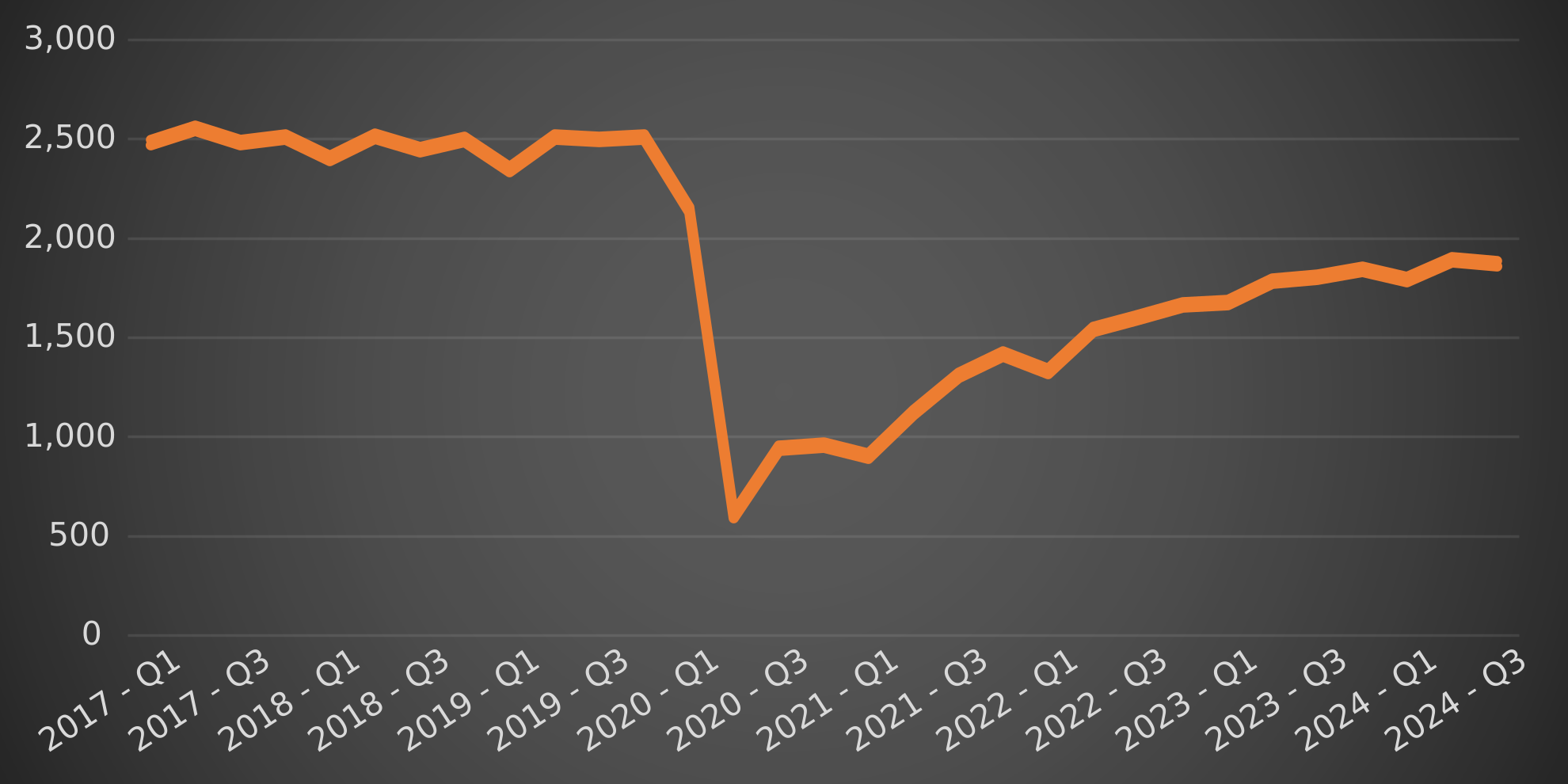
The shelter-in-place measures during the pandemic led to a sharp decline in public transit ridership across the United States. As shown in Figure 1, ridership plunged during this period and has been gradually recovering since. However, by the third quarter of 2024, total public transit ridership in the U.S. remained 500 million—or approximately 20 percent—below pre-pandemic levels.
Figure 1:Total Public Transit Ridership, Millions, Q1 2017 – Q3 2024
The recovery of public transit ridership has been bolstered by return-to-office policies and a robust labor market. Nonetheless, challenges persist. According to a recent study by the American Public Transportation Association, low office occupancy rates continue to impede the full recovery of public transit usage. Standard & Poor’s (S&P) has maintained a negative outlook for U.S. public mass transit operators, citing factors such as the enduring impact of remote work patterns and the expiration of federal pandemic-era financial aid.
In San Francisco, the Bay Area Rapid Transit (BART) has issued a stark warning of an impending “financial crisis.” During the fiscal year 2024, BART’s ridership was 60 percent below the pre-pandemic level. The agency revealed that, due to the prevalence of remote work, fare revenue now covers only 25 percent of operating costs. BART is currently relying on emergency funds, which are projected to be depleted by 2026, leaving a $294 million gap in funding for operating expenses.
BART was not alone in financial difficulties. For example, it has been reported that the Chicago Transit Authority and the Massachusetts Bay Transportation Authority are also grappling with declining ridership and the anticipated loss of federal financial support. New York City is a rare bright spot. The Metropolitan Transportation Authority (MTA) reports that subway ridership frequently exceeds 70 percent of pre-pandemic. Reflecting this resilience, S&P upgraded New York MTA’s revenue bond rating from “BBB+” to “A-“ in September 2023, while revising its outlook from “stable” to “positive.”
Reductions in public transportation services could disproportionately impact low-income families, who rely heavily on these systems for daily commutes and recreational activities. The future remains uncertain as public transit agencies work to address declining ridership and navigate the financial challenges ahead.
A full detailed version of this article, with citations, is available at the link below. For additional inquiries, please contact info@vegaeconomics.com.
 Riding the Budget Crunch: The Financial Challenges Facing U.S. Public Transit